Naturalisation as a British citizen: requirements, fees and timing in 2026
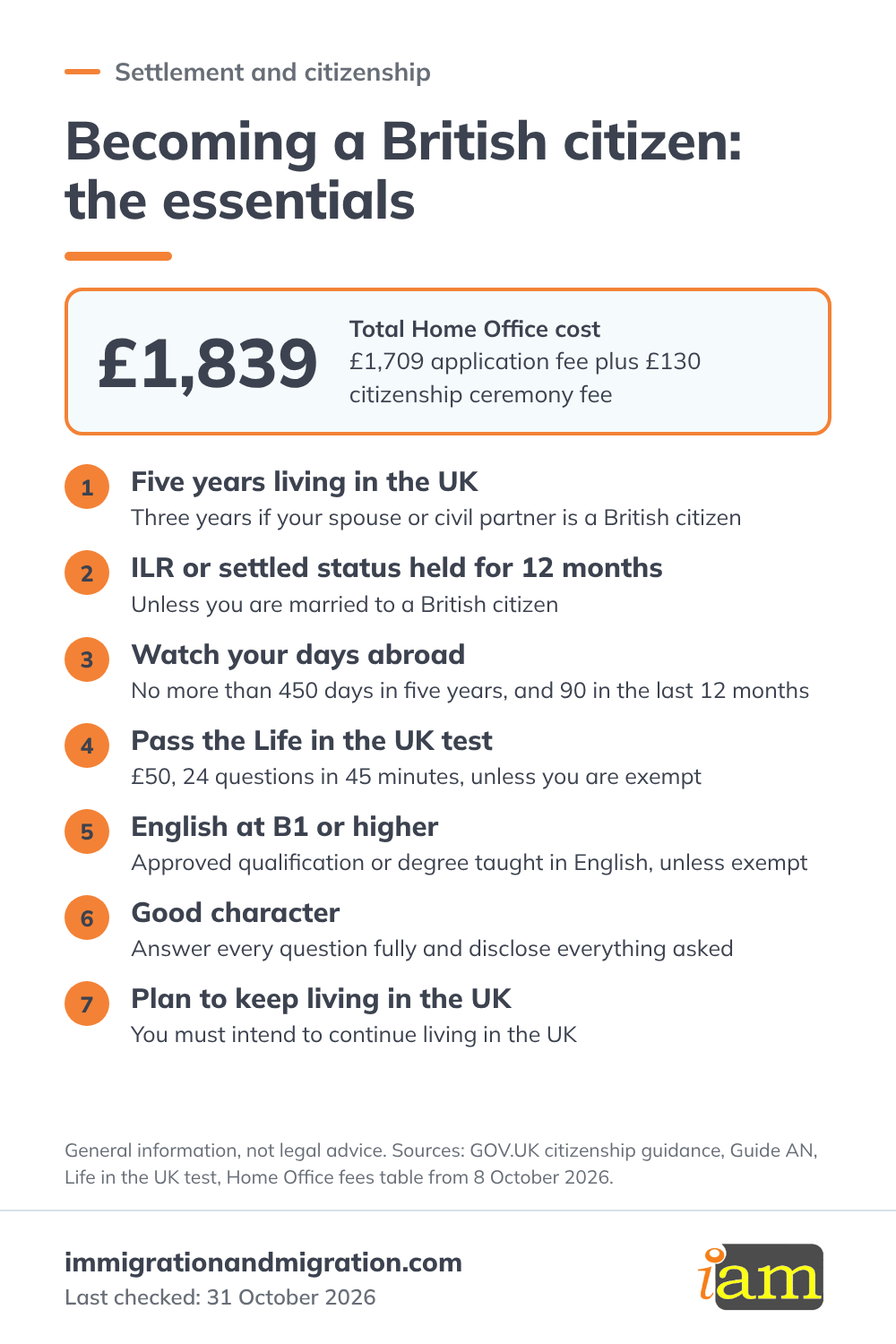
Most adults who hold indefinite leave to remain (ILR) or settled status can apply to become British citizens by naturalisation once they have lived in the UK for five years and held their settled status for 12 months. If you are married to, or the civil partner of, a British citizen, the residence period is three years and you do not need to wait 12 months after settlement. You also need to pass the Life in the UK test, prove your English, be of good character and intend to keep living in the UK. The total Home Office cost is £1,839.
That is the short answer. The detail is where applications go wrong: days spent abroad, the date your settlement was granted, an old immigration problem, or evidence that no longer matches how the Home Office now records status. This guide walks through each requirement in plain English, as the rules stood when we checked GOV.UK on 31 October 2026. It is general information, not legal advice on your situation.
TL;DR
- Most people can apply after 5 years in the UK and holding ILR or settled status for 12 months.
- If you are married to, or the civil partner of, a British citizen, the residence period is 3 years and the 12-month wait does not apply.
- Days abroad matter: no more than 450 in the 5 years and 90 in the last 12 months (270 in 3 years on the spouse route).
- You need the Life in the UK test, English at B1 or higher (unless exempt) and good character.
- The Home Office fee is £1,839: £1,709 for the application plus £130 for the ceremony.
- The proposed 10-year settlement changes do not alter the naturalisation rules that apply to applications made today.
Who can apply to naturalise
GOV.UK says you can usually apply for citizenship if you have ILR, settled status or indefinite leave to enter and you:
- are 18 or over
- have lived in the UK for at least five years (three years if your spouse or civil partner is a British citizen)
- were in the UK exactly five years before the Home Office receives your application (on the five-year route)
- have had your settled status for 12 months, unless you are married to a British citizen
- have not broken UK immigration laws in the qualifying period
- meet the English language requirement and have passed the Life in the UK test
- are of good character
- intend to continue living in the UK
Some people from the EU, Norway, Iceland or Liechtenstein with pre-settled status may also qualify in limited circumstances, so check the GOV.UK page if that applies to you.
The residence requirements, and the days that count
Time outside the UK is one of the first things to check. On the five-year route you must not have spent more than 450 days outside the UK in the five years before you apply, and no more than 90 days in the last 12 months. On the three-year route for spouses and civil partners of British citizens, the limit is 270 days in the three-year period.
The Home Office guide to naturalisation (Guide AN) says there is discretion to disregard absences above the limits in some circumstances. Discretion is not automatic. If you are over the limits, it is worth getting advice before you pay the fee.
Two practical points. First, the start of the qualifying period is fixed by the date the Home Office receives your application, so applying a few weeks too early can mean you fall short. Second, the Home Office may check your travel dates. GOV.UK suggests giving as much detail as you can from your own records, such as emails or boarding passes.
Long absences can also affect your settled status itself. GOV.UK says ILR may be lost after more than two years outside the UK, and settled status after more than five years (four years for Swiss citizens and their family members).
How much naturalisation costs in 2026
The Home Office fees table that applies from 8 October 2026 sets the naturalisation fee at £1,709. A citizenship ceremony fee of £130 is added, so the total is £1,839. There is no fee for giving your biometric information (fingerprints and a photo). The Life in the UK test costs £50, and you pay separately for an English test if you need one.
Guide AN warns that if you apply without meeting the English and Life in the UK requirements, your application may be refused and the fee kept. If you make an untruthful declaration, the fee will not be refunded. We explain the fee breakdown in more detail in UK citizenship costs £1,839: why are the fees so high?
The Life in the UK test
According to GOV.UK:
- it costs £50 and must be booked online at least three days in advance
- there are 24 questions and you have 45 minutes
- Guide AN says you must score 75% or more to pass
- you do not need to take it if you are under 18, 65 or over, have passed it before, or have a long-term physical or mental condition (with an exemption form or a doctor’s letter)
- if you have an eVisa, you use a share code from your UK Visas and Immigration account as your ID when booking
The name on your booking must match your ID exactly. If you passed the test for your ILR application, you do not need to take it again.
The English language requirement
You must show knowledge of English (or Welsh or Scottish Gaelic). Guide AN asks for a Home Office approved qualification in English at B1 level of the Common European Framework of Reference (CEFR) or higher. GOV.UK also accepts a degree taught or researched in English.
You do not need to prove your English if you are 65 or over, if a long-term physical or mental condition means you cannot (supported by a doctor’s exemption form and medical reports), or if you are a national of a listed majority English-speaking country, such as Australia, Canada, New Zealand, the USA or Jamaica. Being from a country where English is an official language is not enough on its own if that country is not on the list.
Good character, including the February 2025 change
The good character requirement is where careful preparation matters most. The Home Office looks at criminality, immigration history, finances, tax, and honesty in the application. Key points from the current nationality guidance:
- Illegal entry: anyone applying for citizenship from 10 February 2025 who previously entered the UK illegally will normally be refused, regardless of how long ago it happened.
- Dangerous journeys: from the same date, a person who arrived without a required entry clearance or electronic travel authorisation, having made a dangerous journey (for example by small boat or hidden in a vehicle), will normally be refused regardless of the time that has passed. Arriving as a passenger on a commercial flight is not a dangerous journey.
- Other immigration breaches: failing to comply with immigration requirements within the 10 years before the decision will normally lead to refusal.
- Criminal record: a custodial sentence of at least 12 months, in the UK or overseas, will normally lead to refusal.
- Finances: debt alone does not normally lead to refusal, especially if agreed repayments are being made. Deliberately building up debt with no intention to repay, or failing to pay tax you owed, can count against you.
- Honesty: you must answer every question fully. If you fail to disclose something that would lead to refusal, the application must be refused, and further applications will normally be refused for 10 years unless the omission was a genuine error.
The guidance does allow exceptional grants in some cases, and there are situations, such as trafficking, where a breach outside the person’s control will normally be disregarded. These are decided case by case. Our earlier update on stricter rules for British citizenship applicants from 2025 covers the background to the February 2025 change.
eVisas and proving your settled status
Most people now prove their immigration status with an eVisa rather than a physical card. Guide AN asks for your unique application number (UAN) or a share code if you have an eVisa showing ILR. It says a biometric residence permit can still be used as evidence for up to 24 months after the expiry date printed on the card.
Before you apply, log in to your UK Visas and Immigration account and check that your details and passport are correct and up to date. If they do not match, fix that first. Our article on eVisa problems when your passport is not linked to your UKVI account explains why this matters.
Earned settlement and the 10-year proposal: what it means for citizenship timing
Settlement comes before citizenship. The Home Office consultation on earned settlement says this plainly: settlement is a prerequisite to being eligible for naturalisation. So any change to how long it takes to get ILR also changes how long it takes to become British.
Here is where things stood on 31 October 2026:
- The government has proposed that the standard qualifying period for settlement should double to 10 years for most people, with shorter periods for those who meet contribution requirements and longer waits for people who have not complied with the rules.
- The consultation, “A Fairer Pathway to Settlement”, ran from 20 November 2025 to 12 February 2026. The GOV.UK page says the Home Office is still analysing responses. No final rules on the 10-year baseline had been published when we checked.
- The consultation says people who already hold settled status are out of scope, and that the government will not take settled status away from those who have it. It asks whether there should be transitional arrangements for people already on a route to settlement.
- It also says reforms to citizenship will follow and will build on the settlement changes, and that changes to the British Nationality Act 1981 would need new primary legislation.
- Separately, the English requirement for settlement on routes such as Skilled Worker rises to B2 from 26 March 2027. That change is about ILR, not citizenship, but it will affect people who have not yet settled.
What this means in practice: if you already hold ILR or settled status and meet the requirements, the proposals do not take your status away, and today’s naturalisation rules apply to applications made today. If you are still working towards ILR, your timeline to citizenship may change, and it is sensible to plan with the current rules and the proposals side by side. For families, our article on whether spouses and families will still qualify for ILR after five years looks at that group in more detail.
Referees, decision times and the ceremony
Your application must be endorsed by two referees, and Guide AN sets out who can act as one. GOV.UK says you will usually get a decision within six months, although some applications take longer, and you will be told if yours will. If you are approved, you will be invited to a citizenship ceremony. Guide AN says you must arrange and attend it within 90 days of receiving your invitation.
Your naturalisation checklist
- Confirm the date your ILR or settled status was granted, and count 12 months forward (unless you are married to a British citizen).
- Work out your qualifying period from the date you plan to submit, then list every trip abroad in that period with dates.
- Check your total days outside the UK against the 450 and 90 day limits (or 270 days on the three-year route).
- Check that you have not broken any immigration rules in the qualifying period.
- Pass the Life in the UK test, or confirm that you are exempt.
- Get your B1 (or higher) English evidence ready, or confirm that you are exempt.
- Review your good character history carefully: convictions, cautions, immigration breaches, debts and tax. Disclose everything the form asks for.
- Log in to your UKVI account and make sure your eVisa details and passport are correct.
- Line up two suitable referees.
- Budget £1,839 for the Home Office fee, plus £50 for the Life in the UK test and any English test cost.
How we can help
Citizenship is often the last step after years of applications, and the cost of a refusal is high. If you want to know whether you are ready to apply, or whether your travel history, an old immigration issue or the settlement proposals change your plan, an Advice Call gets your question answered and your next step confirmed. For background reading, see our pages on British citizenship and naturalisation and registration.
Book an Advice Call (from £47)
Frequently asked questions
How long do I need to live in the UK before I can naturalise?
Usually five years, and you must have held ILR or settled status for 12 months. If you are married to, or the civil partner of, a British citizen, it is three years and you do not need to wait 12 months after settlement.
How much does it cost to apply for British citizenship in 2026?
£1,839 in Home Office fees: £1,709 for the application and £130 for the citizenship ceremony. The Life in the UK test is a further £50.
I spent more than 450 days abroad. Can I still apply?
Possibly. Guide AN says there is discretion to disregard absences above the limits in some circumstances, but it is not automatic. Get advice on your own dates before you pay the fee.
Will the move to a 10-year settlement period affect me if I already have ILR?
The consultation says people who already hold settled status are out of scope of the settlement reforms. The government has said citizenship reforms will follow, but no new citizenship rules had been published when we checked on 31 October 2026.
I entered the UK illegally many years ago. Can I still become British?
For applications made from 10 February 2025, the guidance says previous illegal entry will normally lead to refusal regardless of the time that has passed. There are narrow exceptions, so take advice on your own facts before applying.
Do I still need my BRP?
Most people now use an eVisa. Guide AN asks for a share code or your UAN for an eVisa showing ILR, and says a BRP can be used for up to 24 months after the expiry date printed on it.
Last checked: 31 October 2026. Immigration rules and guidance change often. Always check the current GOV.UK guidance before acting.
Sources
- GOV.UK: Apply for citizenship if you have indefinite leave to remain or settled status
- GOV.UK: Home Office immigration and nationality fees (8 October 2026)
- GOV.UK: Guide AN, naturalisation booklet
- GOV.UK: Life in the UK test
- GOV.UK: Prove your knowledge of English for citizenship and who does not need to prove it
- GOV.UK: Good character requirement, nationality policy guidance
- GOV.UK: Earned settlement consultation, “A Fairer Pathway to Settlement”
- GOV.UK: Statement of changes HC 1691, 5 March 2026 (English at B2 for settlement from 26 March 2027)

He holds a Master’s in International Law, specialising in EU and International Trade Law, and began focusing on immigration during his law degree. Known for his thorough approach to compliance, clear communication, and practical legal strategies, Kobi is committed to delivering solutions that work in the real world.
He also has a knack for reverse-engineering systems to find efficiencies and solve problems others overlook - a skill that makes him particularly effective in uncovering legal pathways others miss.
- HPI visa universities list 2026: which list applies to your degree - 6 November 2026
- Naturalisation as a British citizen: requirements, fees and timing in 2026 - 1 November 2026
- Sponsor licence compliance: what UK sponsors must do in 2026 - 1 November 2026