Sponsor licence compliance: what UK sponsors must do in 2026

If your business holds a sponsor licence, compliance is the work that keeps it. The Home Office expects you to keep the right records for every sponsored worker, check right to work correctly, report certain changes within fixed deadlines, and co-operate with compliance checks, which can happen without notice. Get these right and the licence stays a business asset. Get them wrong and you risk a B-rating, suspension or revocation, which can affect every sponsored worker you employ.
This guide sets out the core duties in plain English. It is based on Part 3 of the Home Office guidance for sponsors (sponsor duties and compliance, version 08/26, valid from 28 August 2026) and Appendix D on record keeping (version 10/26, valid from 8 October 2026). It is general information for employers, not legal advice on a specific situation.
TL;DR
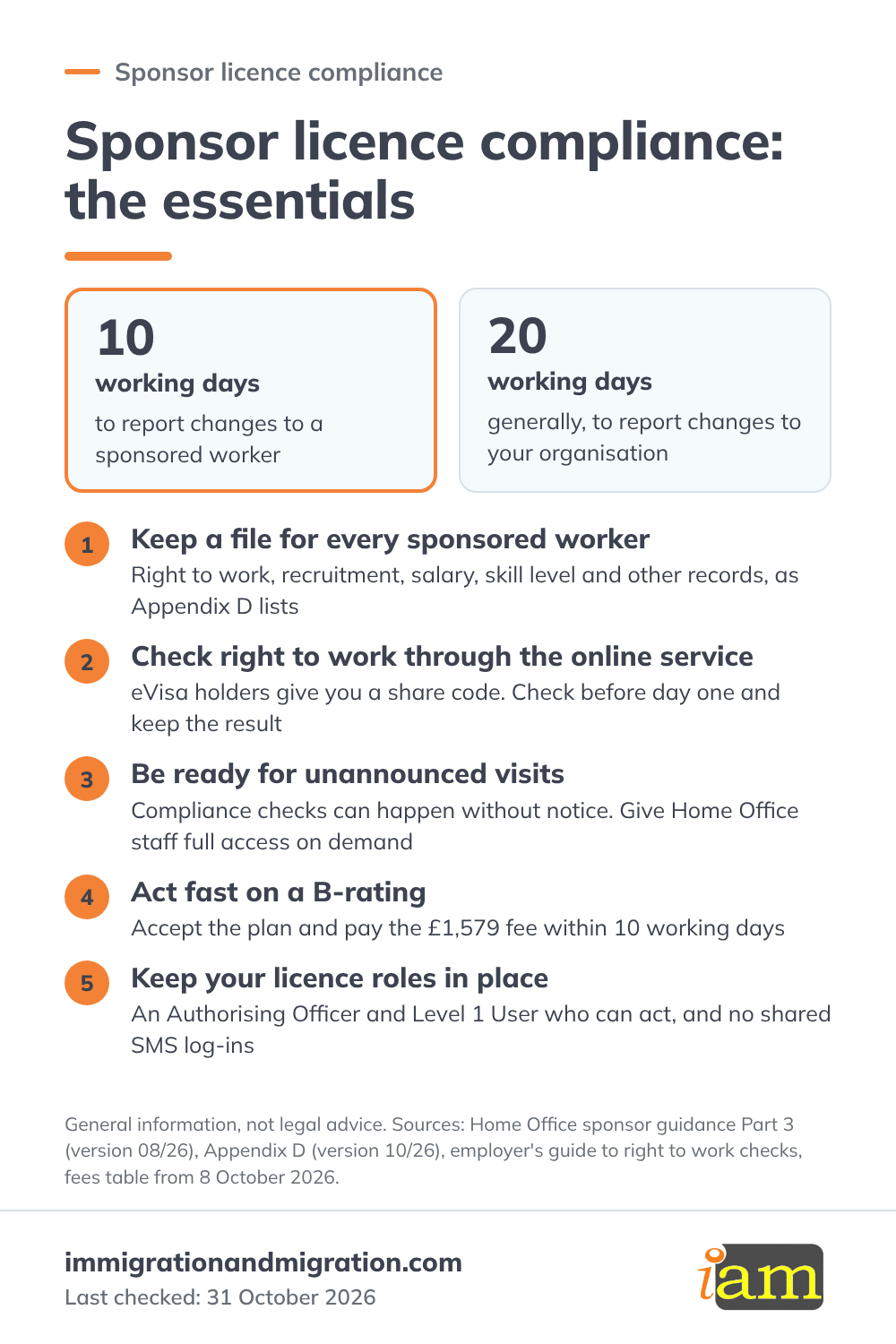
- Report most changes about a sponsored worker in the Sponsor Management System within 10 working days, and changes to your organisation within 20.
- Keep the Appendix D records for every sponsored worker, ready to show on request.
- Check right to work through the Home Office online service: eVisa holders give you a share code, and a BRP is no longer acceptable proof.
- Compliance visits can be announced or unannounced.
- A B-rating stops you assigning new Certificates of Sponsorship until you accept an action plan and pay the £1,579 fee.
- Most licences no longer need renewing since 6 April 2024, so your duties run for as long as you sponsor.
Your duties run for as long as you sponsor
Since 6 April 2024, most sponsor licences no longer need renewing every four years. A licence stays valid unless it is surrendered or revoked. The exceptions are licences for the UK Expansion Worker and Scale-up routes, which last a maximum of four years.
That change removed a deadline, not a duty. There is no renewal date to prepare for, so your systems have to be ready on any working day. The people named on the licence matter too. Part 3 says the Home Office will normally revoke a licence if there is no Level 1 User in place to run day-to-day sponsorship work in the Sponsor Management System (SMS), or no Authorising Officer who meets the requirements. Sharing SMS passwords or one-time passcodes is also listed as a ground that can count against you.
Record keeping: what Appendix D expects on file
Appendix D lists the documents you must keep for each sponsored worker. In summary, the file should hold:
- Right to work evidence: proof of the check you carried out before the worker started, plus date of entry checks where they apply.
- Recruitment evidence: adverts and shortlisting records where a formal labour market test applied, or otherwise evidence of the recruitment you did, or an explanation of how you identified the worker.
- Salary evidence: payslips, proof of each salary payment into the worker’s account, the employment contract or written statement of particulars, and evidence of any allowances.
- Skill level evidence: a detailed job description, relevant qualifications, and any professional registration the role needs.
- Other records: the worker’s National Insurance number, a history of their contact details (which must always be kept up to date), and a record of their absences.
Records can be on paper or electronic, as long as every relevant part is visible. Appendix D says you must keep them throughout the sponsorship and until the earlier of one year after sponsorship ends or the date a compliance officer approves them. Right to work copies have their own rule: the employer’s guide to right to work checks says to keep them securely for the length of the employment and for two years afterwards. If the Home Office asks for a document and you cannot produce it, Part 3 says it will take action.
Right to work checks now that eVisas have replaced BRPs
The Home Office stopped issuing biometric residence permits (BRPs) on 31 October 2024. Most people now hold an eVisa, a digital record of their immigration status. The employer’s guide to right to work checks (1 October 2026 version) says a person with an eVisa can only evidence their right to work through the Home Office online service.
In practice that means:
- The worker generates a nine-character share code beginning with “W” from their UK Visas and Immigration account.
- You enter the code and their date of birth in the “Check a job applicant’s right to work” service.
- Looking at the screen the worker sees is not enough. You need the employer check itself, and a record of it.
- A manual check of an expired physical BRP is not an acceptable check.
The check must happen before employment starts. Workers with time-limited permission, shown by an expiry date, need follow-up checks. GOV.UK says a business that fails to carry out correct checks can face a civil penalty of up to £60,000 for each illegal worker, and Part 3 says a penalty is likely to lead to revocation of the licence. Carrying out the correct checks gives you a defence against the civil penalty.
Reporting duties and the deadlines that apply
Part 3 sets two main clocks. Changes to a sponsored worker’s circumstances must be reported in the SMS within 10 working days of the event. Changes to your organisation must generally be reported within 20 working days. The worker events include:
- The worker does not start within 28 days of the start date on their Certificate of Sponsorship (CoS).
- The worker is absent without permission for more than 10 consecutive working days. The report is due no later than 10 working days after the 10th day of absence.
- Unpaid or reduced-pay absence of more than four weeks in total in a calendar year.
- A reduction in salary below the level on the CoS. Pay rises generally do not need reporting.
- Significant changes to the job, such as a new title or core duties, where the change stays within the same occupation code and does not need a new application.
- A change to the normal work location recorded on the CoS, including a permanent move to home working. A move to hybrid working on its own does not need reporting.
- Sponsorship ending for any reason, for example resignation, dismissal, redundancy, a contract ending early, a withdrawn job offer, a refused application, loss of a required professional registration, or the worker getting settlement.
A suspected breach of the worker’s conditions should be reported as soon as reasonably practicable. On the organisation side, Part 3 gives examples such as a change of ownership, a merger or takeover, and insolvency.
A common way for reports to be missed: a manager agrees something with a worker and the Level 1 User hears about it late, or not at all. The fix is a simple rule that any change to a sponsored worker’s pay, role, location, hours or start date reaches the person who runs the SMS the same week.
Compliance visits can be unannounced
Part 3 says Home Office compliance checks can be announced or unannounced. You must give Home Office staff full access to your premises on demand, and if a sponsored worker works at a third party’s site, such as a client, you must make sure that business knows it may receive an unannounced visit too.
The practical test is whether you could produce each sponsored worker’s file, and explain their real working pattern, within an hour of an officer arriving. If you would struggle, that is the gap to close first.
Ratings, action plans and revocation
Where a sponsor breaches its duties, Part 3 lists the actions the Home Office can take. These include reducing your CoS allocation, downgrading the licence to a B-rating, suspending it, revoking it, cancelling sponsored workers’ permission, and reporting matters to the police.
B-rating and action plans. A B-rated sponsor cannot assign a CoS to a new worker until it has signed an action plan, paid the fee and had its A-rating restored. The action plan fee is £1,579 in the Home Office fees table that applies from 8 October 2026. You have 10 working days to accept the plan and pay. Plans run for three months, and a sponsor can be given one no more than twice in any rolling four-year period. Doing nothing leads to revocation.
Suspension. A licence can be suspended, sometimes without a downgrade first. While it is suspended you cannot assign any CoS. You have 20 working days from the date of the letter to respond, and there is no oral hearing. Sponsored workers who already have valid permission are not affected unless the licence is then revoked.
Revocation. Part 3 sets out three groups of grounds. Some mean the Home Office can revoke immediately and without warning. Others, which include failing to meet sponsor duties and failing to co-operate with compliance checks, normally lead to revocation unless there are exceptional circumstances. A third group is discretionary. There is no right of appeal against revocation.
Revocation reaches your workforce. Any CoS you have assigned becomes invalid. Workers who were not involved in the breach normally have their permission shortened so that 60 calendar days remain, and they must leave or switch to another route in that time. Workers who were complicit normally lose all their remaining permission.
Cooling-off periods. After revocation you cannot apply again until at least 12 months have passed from the date you were notified. That rises to at least 24 months if a licence has been revoked more than once. Some civil penalties and convictions can extend the period.
Practical sponsor licence compliance checklist
- Confirm your Authorising Officer and Level 1 User are in place, current and able to act, and that nobody shares SMS log-in details.
- Keep one file per sponsored worker that matches the Appendix D headings: right to work, recruitment, salary, skill level and other records.
- Run right to work checks for eVisa holders through the online service before day one, keep the result, and diary follow-up checks for time-limited permission.
- Check that every sponsored worker’s actual salary is not below the level on their CoS.
- Track unauthorised absence daily, so the 10 working day trigger is never missed.
- Route every change to pay, job title, duties, location, hours and leaving dates to the Level 1 User within the same week.
- Report worker changes within 10 working days and organisation changes within 20 working days, and keep a note of when each report was made.
- Brief reception and any client sites that an unannounced compliance visit can happen.
- Diary a review of your files at least every quarter, and after any restructure, merger or change of ownership.
How we can help
Sponsorship works best when someone owns it. We work with UK employers who want their sponsor licence run like a system: clear records, reports made on time, and files that would stand up to a compliance visit. If you are preparing for a first licence, our guide to preparing for a sponsorship licence is a good starting point, and our overview of the points-based system for employers explains how sponsorship fits together. For the latest rule changes, see our update on sponsor licence changes in 2026.
If you would like your current set-up looked at against the guidance, a Global Talent Unlocking Call is a focused conversation about your licence, your sponsored workers, your records and your reporting, and the next steps that would close any gaps.
Book your Global Talent Unlocking Call
Frequently asked questions
Does a sponsor licence still expire after four years?
For most routes, no. Since 6 April 2024 a licence stays valid unless it is surrendered or revoked. UK Expansion Worker and Scale-up licences are the exception and last a maximum of four years. Your duties continue for as long as you hold the licence.
How long do we have to report a change in the Sponsor Management System?
Changes to a sponsored worker’s circumstances must be reported within 10 working days of the event. Changes to your organisation generally have 20 working days. Unauthorised absence has its own rule: report no later than 10 working days after the 10th consecutive working day of absence.
Can the Home Office visit without warning?
Yes. Part 3 says compliance checks can be announced or unannounced, and you must give Home Office staff full access to your premises on demand.
Can we still accept a BRP as proof of right to work?
BRPs stopped being issued on 31 October 2024, and a manual check of an expired BRP is not acceptable. A worker with an eVisa can only prove their right to work through the Home Office online service, using a share code.
What does a B-rating mean for hiring?
You cannot assign a Certificate of Sponsorship to a new worker until you have signed an action plan, paid the £1,579 fee and had your A-rating restored. If you do not act, the licence will be revoked.
If our licence is revoked, when can we apply again?
Normally not until at least 12 months after the date you were notified of the revocation, or at least 24 months if a licence has been revoked more than once. Some civil penalties and convictions can extend this.
Last checked: 31 October 2026. Immigration rules and guidance change often. Always check the current GOV.UK guidance before acting.
Sources
- GOV.UK: Workers and Temporary Workers guidance for sponsors, Part 3: sponsor duties and compliance (version 08/26)
- GOV.UK: Guidance for sponsors, Appendix D: record keeping duties (version 10/26)
- GOV.UK: Employer’s guide to right to work checks (1 October 2026)
- GOV.UK: Penalties for employing illegal workers
- GOV.UK: Home Office immigration and nationality fees (8 October 2026)

He holds a Master’s in International Law, specialising in EU and International Trade Law, and began focusing on immigration during his law degree. Known for his thorough approach to compliance, clear communication, and practical legal strategies, Kobi is committed to delivering solutions that work in the real world.
He also has a knack for reverse-engineering systems to find efficiencies and solve problems others overlook - a skill that makes him particularly effective in uncovering legal pathways others miss.
- HPI visa universities list 2026: which list applies to your degree - 6 November 2026
- Naturalisation as a British citizen: requirements, fees and timing in 2026 - 1 November 2026
- Sponsor licence compliance: what UK sponsors must do in 2026 - 1 November 2026